

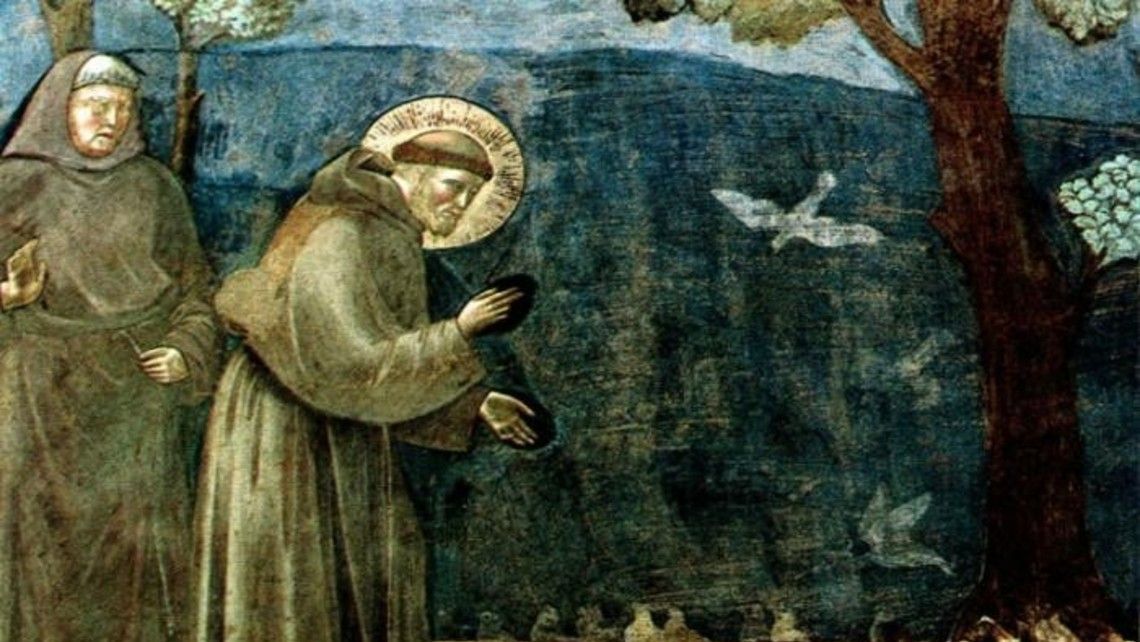
Hello Friends and members, Each year, close to the feast day of St. Francis of Assisi, clergy from the churches of Borrego gather to bless animals people bring to the Christmas Circle. Many bring household pets, dogs, cats, sometimes tortoises and birds. Some even bring pictures of deceased beloved pets or of pets they cannot easily bring in. This year, Fr. David Madsen of St. Barnabas Episcopal, Pastor Mateo of Community United Methodist and Fr. Emilio Magana of St. Richard’s did prayers and blessings for 50-60 animals people brought in. Why do this? Decades ago, some larger churches, New York City’s Cathedral of St. John the Divine, began having blessings of animals on a day close to St. Francis’ feast on October 4. Francis, who died in 1226, was the founder of communities of brothers and sisters and lay people in Tuscany. These groups had a particular focus on assisting the poor, homeless, ill, in short, all people in need. The Borrego Ministers Association (BMA) has exactly the same focus. Francis had the extraordinary vision to see all of the world around us as united to us as family. He spoke of Sister Moon and Brother Sun for example. In his beautiful canticle or song of praise, he bursts into thanksgiving to God for all the wonders of nature around us. Francis also seems to have had an amazing ability to relate to animals. He talked a wolf in the town of Gubbio out of preying upon the shepherds and farmers. It’s reported that when Francis spoke to crowds that had gathered to hear about God’s love for them, that even the birds would sit quietly in the tree branches, seemingly listing to him. One Christmas, Francis got the townspeople to bring animals to a cave where he set up the first ever creche or nativity scene, complete with sheep, oxen and donkeys, there as in the cave and stable where the baby Jesus was born and put, wrapped up, into a feed trough or manger. Supposedly the domestic animals kept him warm with their breath. The UN, the EU and many other international organizations and religious leaders have recognized St. Francis as a holy man and made him a patron saint of the movement to save our environment, and reduce the damaging effects of climate change. People of all faiths and none at all respect Francis as a lover of all the natural world. So it is fitting that our pets are blessed on this day, following his example of love

by David Madsen When I was eighteen, I made a private commitment that has shaped my life for sixty six years: I would follow Jesus whether he “saved” me or not. After growing up in a Pentecostal fundamentalist church, especially as the “ornery” preacher’s kid who needed to get saved every time an evangelist came through town, I no longer trusted my own salvation. I could be saved on Sunday morning and convinced I was going to hell by Wednesday night. So I made a quiet promise: I will follow Jesus, even if it is one sided. A few months later I was living with my family in Dodge City, Kansas. My father pastored a small church on a single lane road shared only with the rectory, about 200 yards apart, tucked beside the city golf course. It was an ordinary place, but something extraordinary happened there. Most evenings, I slipped into the church alone. No music. No preaching. No altar call. Just silence. I didn’t go there to pray the way I had been taught. I went to listen. And in that quiet, something began to happen that I had no language for. I would lie on my back near the altar and wait. And God came. Not in words or visions, but in a presence so full I sometimes wondered if I could bear it. Night after night for nearly two weeks, the same overwhelming nearness returned. I had never been taught about anything like this. If I had tried to explain it to the Pentecostal world I grew up in, they would have looked at me like I was from another planet. Years later, I found writers who helped me understand what had happened. Rudolf Otto used the word numinous to describe the holy not as moral purity but as overpowering mystery, the “mysterium tremendum”, the experience that shakes a person to the core.¹ William James wrote that true religious experience begins with those who encounter the unseen world firsthand, distinguishing it from “second hand religion,” the beliefs people inherit through tradition.² What happened to me in Dodge City was firsthand. It was uninvited, unstructured, unearned. It was God finding me in the quiet when I had finally stopped trying to save myself. I have carried those nights with me for sixty six years. They did not make me perfect or certain or immune to doubt. But they gave me a center a quiet place inside where God still meets me, without requirements, without fear, without the need to prove anything. And if someone today finds themselves confused or overwhelmed by what they’re experiencing, I want them to know this: sometimes the deepest spiritual moments arrive without instruction, without permission, and without a name. Sometimes the holiest thing you can do is simply lie still and let God find you. Two things that have shaped my life through experience with the unknown: • God is everywhere. There is nowhere “outside” of God’s presence. • And the Spirit is always more; more than words, more than any attempts to define the Holy. So I don’t fear the unknown. It’s already filled with God. And I don’t limit my understanding of the Spirit. She’s already moving beyond my borders. Father Dave+

It’s been on my mind lately to not only prepare my heart and mind for Sunday morning worship but io carry that early morning tranquility into the preservice atmosphere of St. Barnabas. Every Sunday begins the same way for me: morning prayers with Naomi, followed by one of the quiet videos that helps us get settled into the day. The one example I will share with you today is just one way of practicing this use of time and space. My problem lately is getting to church and allowing all sorts of church business and problems to destroy the atmosphere. The distracted mind affects everything, worship, liturgy, sermon, Lords Table and Coffee hour. Our morning atmosphere sets the tone for the entire day. By intentionally bringing a peaceful temperament into our early hours, we create a sanctuary of restfulness, not just for ourselves, but for everyone we encounter. Reclaiming this quiet time beautifully prepares our hearts for worship. And sometimes we need to just drop in and see what condition our condition is in. Time to tune our hearts to be in tune with the Spirit. “God is Spirit and those who worship Him must worship in spirit and truth” (John 4:24). I will include one example of how I prepare my mind and spirit for Sunday morning worship. This is just one suggestion. You may have others to include. If so, please let me know. Try anchoring your morning with Gregorian chant. allow Illumination by Dan Gibson’s Solitudes blending historic Latin chants with calming sounds of God’s creation. While these chants carry rich scholastic history, my takeaway is pastoral, quieting my mind and turning my focus toward the divine. Here’s one option: This Sunday early morning light a candle, maybe a stick of incense, and let sacred sounds fill your home as you prepare for church. Arrive at St. Barnabas already tuned into God’s peace by opening the peaceful Gregorian Chants album on YouTube. Father Dave+
Hello Friends and members, Each year, close to the feast day of St. Francis of Assisi, clergy from the churches of Borrego gather to bless animals people bring to the Christmas Circle. Many bring household pets, dogs, cats, sometimes tortoises and birds. Some even bring pictures of deceased beloved pets or of pets they cannot easily bring in. This year, Fr. David Madsen of St. Barnabas Episcopal, Pastor Mateo of Community United Methodist and Fr. Emilio Magana of St. Richard’s did prayers and blessings for 50-60 animals people brought in. Why do this? Decades ago, some larger churches, New York City’s Cathedral of St. John the Divine, began having blessings of animals on a day close to St. Francis’ feast on October 4. Francis, who died in 1226, was the founder of communities of brothers and sisters and lay people in Tuscany. These groups had a particular focus on assisting the poor, homeless, ill, in short, all people in need. The Borrego Ministers Association (BMA) has exactly the same focus. Francis had the extraordinary vision to see all of the world around us as united to us as family. He spoke of Sister Moon and Brother Sun for example. In his beautiful canticle or song of praise, he bursts into thanksgiving to God for all the wonders of nature around us. Francis also seems to have had an amazing ability to relate to animals. He talked a wolf in the town of Gubbio out of preying upon the shepherds and farmers. It’s reported that when Francis spoke to crowds that had gathered to hear about God’s love for them, that even the birds would sit quietly in the tree branches, seemingly listing to him. One Christmas, Francis got the townspeople to bring animals to a cave where he set up the first ever creche or nativity scene, complete with sheep, oxen and donkeys, there as in the cave and stable where the baby Jesus was born and put, wrapped up, into a feed trough or manger. Supposedly the domestic animals kept him warm with their breath. The UN, the EU and many other international organizations and religious leaders have recognized St. Francis as a holy man and made him a patron saint of the movement to save our environment, and reduce the damaging effects of climate change. People of all faiths and none at all respect Francis as a lover of all the natural world. So it is fitting that our pets are blessed on this day, following his example of love
by David Madsen When I was eighteen, I made a private commitment that has shaped my life for sixty six years: I would follow Jesus whether he “saved” me or not. After growing up in a Pentecostal fundamentalist church, especially as the “ornery” preacher’s kid who needed to get saved every time an evangelist came through town, I no longer trusted my own salvation. I could be saved on Sunday morning and convinced I was going to hell by Wednesday night. So I made a quiet promise: I will follow Jesus, even if it is one sided. A few months later I was living with my family in Dodge City, Kansas. My father pastored a small church on a single lane road shared only with the rectory, about 200 yards apart, tucked beside the city golf course. It was an ordinary place, but something extraordinary happened there. Most evenings, I slipped into the church alone. No music. No preaching. No altar call. Just silence. I didn’t go there to pray the way I had been taught. I went to listen. And in that quiet, something began to happen that I had no language for. I would lie on my back near the altar and wait. And God came. Not in words or visions, but in a presence so full I sometimes wondered if I could bear it. Night after night for nearly two weeks, the same overwhelming nearness returned. I had never been taught about anything like this. If I had tried to explain it to the Pentecostal world I grew up in, they would have looked at me like I was from another planet. Years later, I found writers who helped me understand what had happened. Rudolf Otto used the word numinous to describe the holy not as moral purity but as overpowering mystery, the “mysterium tremendum”, the experience that shakes a person to the core.¹ William James wrote that true religious experience begins with those who encounter the unseen world firsthand, distinguishing it from “second hand religion,” the beliefs people inherit through tradition.² What happened to me in Dodge City was firsthand. It was uninvited, unstructured, unearned. It was God finding me in the quiet when I had finally stopped trying to save myself. I have carried those nights with me for sixty six years. They did not make me perfect or certain or immune to doubt. But they gave me a center a quiet place inside where God still meets me, without requirements, without fear, without the need to prove anything. And if someone today finds themselves confused or overwhelmed by what they’re experiencing, I want them to know this: sometimes the deepest spiritual moments arrive without instruction, without permission, and without a name. Sometimes the holiest thing you can do is simply lie still and let God find you. Two things that have shaped my life through experience with the unknown: • God is everywhere. There is nowhere “outside” of God’s presence. • And the Spirit is always more; more than words, more than any attempts to define the Holy. So I don’t fear the unknown. It’s already filled with God. And I don’t limit my understanding of the Spirit. She’s already moving beyond my borders. Father Dave+
It’s been on my mind lately to not only prepare my heart and mind for Sunday morning worship but io carry that early morning tranquility into the preservice atmosphere of St. Barnabas. Every Sunday begins the same way for me: morning prayers with Naomi, followed by one of the quiet videos that helps us get settled into the day. The one example I will share with you today is just one way of practicing this use of time and space. My problem lately is getting to church and allowing all sorts of church business and problems to destroy the atmosphere. The distracted mind affects everything, worship, liturgy, sermon, Lords Table and Coffee hour. Our morning atmosphere sets the tone for the entire day. By intentionally bringing a peaceful temperament into our early hours, we create a sanctuary of restfulness, not just for ourselves, but for everyone we encounter. Reclaiming this quiet time beautifully prepares our hearts for worship. And sometimes we need to just drop in and see what condition our condition is in. Time to tune our hearts to be in tune with the Spirit. “God is Spirit and those who worship Him must worship in spirit and truth” (John 4:24). I will include one example of how I prepare my mind and spirit for Sunday morning worship. This is just one suggestion. You may have others to include. If so, please let me know. Try anchoring your morning with Gregorian chant. allow Illumination by Dan Gibson’s Solitudes blending historic Latin chants with calming sounds of God’s creation. While these chants carry rich scholastic history, my takeaway is pastoral, quieting my mind and turning my focus toward the divine. Here’s one option: This Sunday early morning light a candle, maybe a stick of incense, and let sacred sounds fill your home as you prepare for church. Arrive at St. Barnabas already tuned into God’s peace by opening the peaceful Gregorian Chants album on YouTube. Father Dave+