

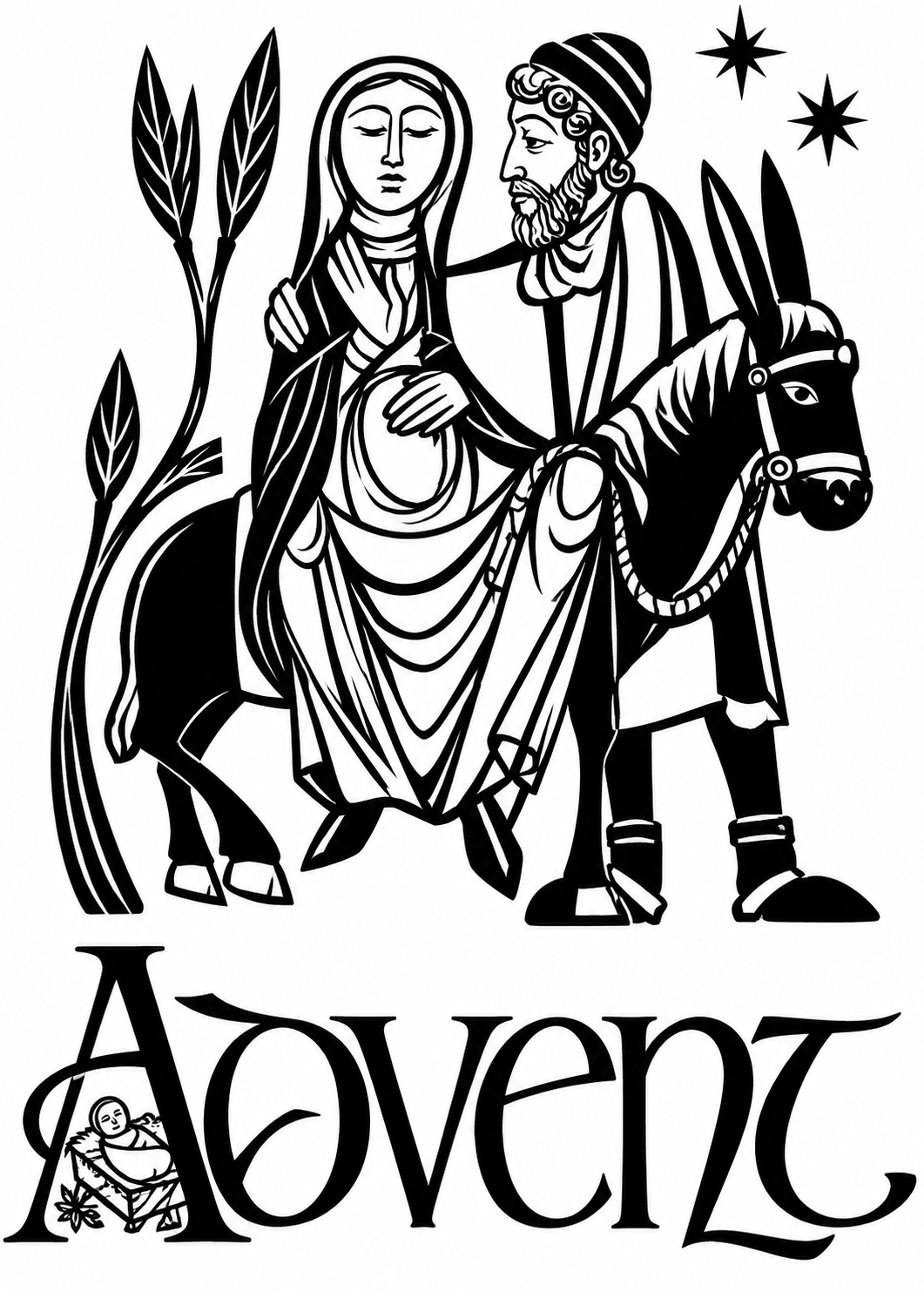
Advent, Part One By Fr. Michael Plekon The word Advent means “coming.” It is the start of the church year, which will take us through to Christmas, Epiphany, Lent, Holy Week and Easter, the Ascension and Pentecost and the many “green” weeks of vestments till we come back to Advent next November 28, when we start all over again. The big coming of course is the birth of Our Lord on December 25, called “Christmas” because we celebrate Mass or the Eucharist on Christmas Eve and on Christmas day, rejoicing with the angels and shepherds that this little baby came to us—and has never left us! In the four short weeks of Advent, the shortest of the church seasons, we wear blue vestments to honor Jesus’ mother Mary and to remember all the prophets and holy people who came before Jesus preparing his way. We listen in the Advent readings especially to the prophet Isaiah, and from Jesus’ own cousin, the last of the prophets, John the Baptist. In the first Sunday, Isaiah talks of the intense waiting for God to come. He says we are like the clay that a potter uses to make beautiful objects, cups, bowls, dishes, for our food. We are reminded in the gospel for Advent 1 that there is an end to everything, including our lives. How are we living? What are we doing with our time and resources? Can we try to do better, to do more good? On Advent 2, Isaiah comforts us, and says a voice cries out in the wilderness to prepare the Lord’s way. If we know Handel’s Messiah , these lines will be familiar. God is coming, will come, not just in the birth of Jesus, but every day to which we wake up. In the gospel for Advent 2 we come face to face with John the Baptist. He points to the One coming, Jesus, and tells us to prepare the way. I will return with the other Sundays of Advent and to talk about what Christmas is in addition to the tree, the gifts and lights and good food. Till then, prepare the way of the Lord. Authorial Interview: Fr. Michael Plekon Michael Plekon / Pastors, Their Life and Work Today Saints As They Really Are

Hello Friends & Members, It was the summer of 1971. I was 19, working at a youth ministry called Teen Challenge in Denver, Colorado, getting ready to start Bible school in the fall. The Mission Pastor asked what I wanted to do that summer. And, being young and perhaps a little too confident, I said, “I want to work the streets from 10 PM to 4 AM.” He looked at me the way a pastor looks at a teenager who has just said something that will give him heartburn. But he was a good friend of my father’s from Bible college, so he agreed — probably against his better judgment. One early morning, near the end of my shift, I met a young runaway boy — maybe fourteen. It was clear, even to a ‘teenage evangelist’, that what he needed wasn’t a prayer or a sermon. He was hungry. So I asked if I could buy him a burger at the 24‑hour diner on the corner. We sat down. I ordered him a hamburger and a glass of milk. And when the food arrived, this young man — tough, street‑worn, trying so hard to be older than he was — he just broke. He started crying. Not polite tears. Not “I have something in my eye” tears. He wept. The food, the warmth, the simple fact that someone cared — it undid him. I can still see it like it was yesterday: the small diner, the Formica table, the boy hunched over his plate, the waiter pretending not to stare, the clatter of the kitchen, the quiet holiness of that moment. It was an epiphany. Something shifted in me. I understood what God was showing me and doing in me. And I knew — with a clarity that has never left me — that my life would always be tied to people on the margins. That God would keep placing me at tables like that one, with people who needed compassion more than judgment, presence more than perfection. Wherever I’ve gone, that moment has gone with me. Emmanuel — God with us — is not an idea. It’s a table in a diner at 4 AM. It’s a lonely, hungry teenager and a hamburger. It’s the quiet realization that God shows up in the places we don’t expect, through the people we don’t expect, in the hours we don’t expect. I close with a song by Carole King, You Got a Friend. Blessings on your day, Father Dave+
Advent, Part One By Fr. Michael Plekon The word Advent means “coming.” It is the start of the church year, which will take us through to Christmas, Epiphany, Lent, Holy Week and Easter, the Ascension and Pentecost and the many “green” weeks of vestments till we come back to Advent next November 28, when we start all over again. The big coming of course is the birth of Our Lord on December 25, called “Christmas” because we celebrate Mass or the Eucharist on Christmas Eve and on Christmas day, rejoicing with the angels and shepherds that this little baby came to us—and has never left us! In the four short weeks of Advent, the shortest of the church seasons, we wear blue vestments to honor Jesus’ mother Mary and to remember all the prophets and holy people who came before Jesus preparing his way. We listen in the Advent readings especially to the prophet Isaiah, and from Jesus’ own cousin, the last of the prophets, John the Baptist. In the first Sunday, Isaiah talks of the intense waiting for God to come. He says we are like the clay that a potter uses to make beautiful objects, cups, bowls, dishes, for our food. We are reminded in the gospel for Advent 1 that there is an end to everything, including our lives. How are we living? What are we doing with our time and resources? Can we try to do better, to do more good? On Advent 2, Isaiah comforts us, and says a voice cries out in the wilderness to prepare the Lord’s way. If we know Handel’s Messiah , these lines will be familiar. God is coming, will come, not just in the birth of Jesus, but every day to which we wake up. In the gospel for Advent 2 we come face to face with John the Baptist. He points to the One coming, Jesus, and tells us to prepare the way. I will return with the other Sundays of Advent and to talk about what Christmas is in addition to the tree, the gifts and lights and good food. Till then, prepare the way of the Lord. Authorial Interview: Fr. Michael Plekon Michael Plekon / Pastors, Their Life and Work Today Saints As They Really Are
Hello Friends & Members, It was the summer of 1971. I was 19, working at a youth ministry called Teen Challenge in Denver, Colorado, getting ready to start Bible school in the fall. The Mission Pastor asked what I wanted to do that summer. And, being young and perhaps a little too confident, I said, “I want to work the streets from 10 PM to 4 AM.” He looked at me the way a pastor looks at a teenager who has just said something that will give him heartburn. But he was a good friend of my father’s from Bible college, so he agreed — probably against his better judgment. One early morning, near the end of my shift, I met a young runaway boy — maybe fourteen. It was clear, even to a ‘teenage evangelist’, that what he needed wasn’t a prayer or a sermon. He was hungry. So I asked if I could buy him a burger at the 24‑hour diner on the corner. We sat down. I ordered him a hamburger and a glass of milk. And when the food arrived, this young man — tough, street‑worn, trying so hard to be older than he was — he just broke. He started crying. Not polite tears. Not “I have something in my eye” tears. He wept. The food, the warmth, the simple fact that someone cared — it undid him. I can still see it like it was yesterday: the small diner, the Formica table, the boy hunched over his plate, the waiter pretending not to stare, the clatter of the kitchen, the quiet holiness of that moment. It was an epiphany. Something shifted in me. I understood what God was showing me and doing in me. And I knew — with a clarity that has never left me — that my life would always be tied to people on the margins. That God would keep placing me at tables like that one, with people who needed compassion more than judgment, presence more than perfection. Wherever I’ve gone, that moment has gone with me. Emmanuel — God with us — is not an idea. It’s a table in a diner at 4 AM. It’s a lonely, hungry teenager and a hamburger. It’s the quiet realization that God shows up in the places we don’t expect, through the people we don’t expect, in the hours we don’t expect. I close with a song by Carole King, You Got a Friend. Blessings on your day, Father Dave+